







提醒成功




 微信/QQ登录
搜索


 首页
首页

Rabbit polyclonal antibody to PER1
-
货号:
54400 -
别名:
Period circadian protein homolog 1; hPER1; Circadian clock protein PERIOD 1; Circadian pacemaker protein Rigui; PER1; KIAA0482; PER; RIGUI -
应用:
WB -
反应种属:
Human -
抗体类型:
Primary antibody -
Swissprot:
O15534 -
规格:
-
数量:
-+ -
说明书:

目录价¥1180



Rabbit polyclonal antibody to PER1
Description |
|---|
Transcriptional repressor which forms a core component of the circadian clock. The circadian clock, an internal time~keeping system, regulates various physiological processes through the generation of approximately 24 hour circadian rhythms in gene expression, which are translated into rhythms in metabolism and behavior. It is derived from the Latin roots 'circa' (about) and 'diem' (day) and acts as an important regulator of a wide array of physiological functions including metabolism, sleep, body temperature, blood pressure, endocrine, immune, cardiovascular, and renal function. Consists of two major components: the central clock, residing in the suprachiasmatic nucleus (SCN) of the brain, and the peripheral clocks that are present in nearly every tissue and organ system. Both the central and peripheral clocks can be reset by environmental cues, also known as Zeitgebers (German for 'timegivers'). The predominant Zeitgeber for the central clock is light, which is sensed by retina and signals directly to the SCN. The central clock entrains the peripheral clocks through neuronal and hormonal signals, body temperature and feeding~related cues, aligning all clocks with the external light/dark cycle. Circadian rhythms allow an organism to achieve temporal homeostasis with its environment at the molecular level by regulating gene expression to create a peak of protein expression once every 24 hours to control when a particular physiological process is most active with respect to the solar day. Transcription and translation of core clock components (CLOCK, NPAS2, BMAL1, BMAL2, PER1, PER2, PER3, CRY1 and CRY2) plays a critical role in rhythm generation, whereas delays imposed by post~translational modifications (PTMs) are important for determining the period (tau) of the rhythms (tau refers to the period of a rhythm and is the length, in time, of one complete cycle). A diurnal rhythm is synchronized with the day/night cycle, while the ultradian and infradian rhythms have a period shorter and longer than 24 hours, respectively. Disruptions in the circadian rhythms contribute to the pathology of cardiovascular diseases, cancer, metabolic syndromes and aging. A transcription/translation feedback loop (TTFL) forms the core of the molecular circadian clock mechanism. Transcription factors, CLOCK or NPAS2 and BMAL1 or BMAL2, form the positive limb of the feedback loop, act in the form of a heterodimer and activate the transcription of core clock genes and clock~controlled genes (involved in key metabolic processes), harboring E~box elements (5'~CACGTG~3') within their promoters. The core clock genes: PER1/2/3 and CRY1/2 which are transcriptional repressors form the negative limb of the feedback loop and interact with the CLOCK|NPAS2~BMAL1|BMAL2 heterodimer inhibiting its activity and thereby negatively regulating their own expression. This heterodimer also activates nuclear receptors NR1D1/2 and RORA/B/G, which form a second feedback loop and which activate and repress BMAL1 transcription, respectively. Regulates circadian target genes expression at post~transcriptional levels, but may not be required for the repression at transcriptional level. Controls PER2 protein decay. Represses CRY2 preventing its repression on CLOCK/BMAL1 target genes such as FXYD5 and SCNN1A in kidney and PPARA in liver. Besides its involvement in the maintenance of the circadian clock, has an important function in the regulation of several processes. Participates in the repression of glucocorticoid receptor NR3C1/GR~induced transcriptional activity by reducing the association of NR3C1/GR to glucocorticoid response elements (GREs) by BMAL1:CLOCK. Plays a role in the modulation of the neuroinflammatory state via the regulation of inflammatory mediators release, such as CCL2 and IL6. In spinal astrocytes, negatively regulates the MAPK14/p38 and MAPK8/JNK MAPK cascades as well as the subsequent activation of NFkappaB. Coordinately regulates the expression of multiple genes that are involved in the regulation of renal sodium reabsorption. Can act as gene expression activator in a gene and tissue specific manner, in kidney enhances WNK1 and SLC12A3 expression in collaboration with CLOCK. Modulates hair follicle cycling. Represses the CLOCK~BMAL1 induced transcription of BHLHE40/DEC1. |
Specification |
|
|---|---|
| Aliases | Period circadian protein homolog 1; hPER1; Circadian clock protein PERIOD 1; Circadian pacemaker protein Rigui; PER1; KIAA0482; PER; RIGUI |
| Swissprot | O15534 |
| WB Predicted band size | ~140kDa |
| Host/Isotype | Rabbit IgG |
| Antibody Type | Primary antibody |
| Storage | Store at 4°C short term. Aliquot and store at ~20°C long term. Avoid freeze~thaw cycles. |
| Species Reactivity | Human |
| Immunogen | Synthetic peptide, corresponding to Human PER1. |
| Formulation | 1mg/ml in PBS with 0.02% sodium azide, 50% glycerol, pH7.2. |
Application |
|
|---|---|
| WB | 1/1000~1/2000 |
Product Image
For Reseach Only
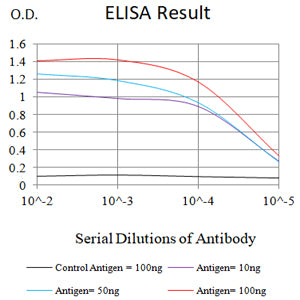
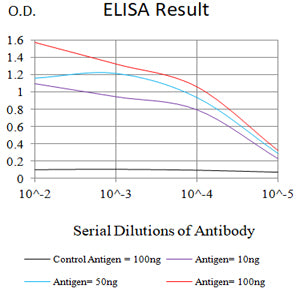
Application Key:WB - Western Blot | IHC - Immunohistochemistry | ICC - Immunocytochemistry | FCM - Flow Cytometry | ELISA - Enzyme-linked Immunosorbent Assay | IP - Immunoprecipitation
#54400
相关产品



联系方式
CONTACT-
联系电话:
0731-88388785 -
公司邮箱:
sales@promab.cn -
公司地址:
湖南省长沙市高新开发区林语路239号顺畅产业园5楼
 官方微信
官方微信
产品中心
Product技术服务
service客户留言
message