







提醒成功




 微信/QQ登录
搜索


 首页
首页
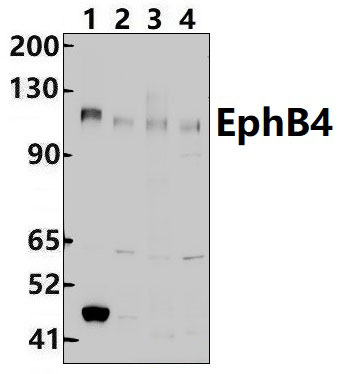
Western blot (WB) analysis of EphB4 (E601) polyclonal antibody at 1:500 dilution
Lane1:MCF~7 whole cell lysate(30ug)
Lane2:HepG2 whole cell lysate(30ug)
Lane3:3T3~L1 whole cell lysate(30ug)
Lane4:PC12 whole cell lysate(30ug)
Rabbit polyclonal antibody to EphB4 (E601)
-
货号:
53534 -
别名:
Ephrin type~B receptor 4; Hepatoma transmembrane kinase; Tyrosine~protein kinase TYRO11; EPHB4; HTK; MYK1; TYRO11 -
应用:
WB IHC IF IP -
反应种属:
Human,Rat,Mouse -
抗体类型:
Primary antibody -
Swissprot:
P54760 -
规格:
-
数量:
-+ -
说明书:

目录价¥1180



Rabbit polyclonal antibody to EphB4 (E601)
Description |
|---|
The Eph receptors are the largest known family of receptor tyrosine kinases (RTKs). They can be divided into two groups based on sequence similarity and on their preference for a subset of ligands: EphA receptors bind to a glycosylphosphatidylinositol~anchored ephrin A ligand; EphB receptors bind to ephrin B proteins that have a transmembrane and cytoplasmic domain. Research studies have shown that Eph receptors and ligands may be involved in many diseases including cancer. Both ephrin A and B ligands have dual functions. As RTK ligands, ephrins stimulate the kinase activity of Eph receptors and activate signaling pathways in receptor~expressing cells. The ephrin extracellular domain is sufficient for this function as long as it is clustered. The second function of ephrins has been described as "reverse signaling", whereby the cytoplasmic domain becomes tyrosine phosphorylated, allowing interactions with other proteins that may activate signaling pathways in the ligand~expressing cells. Various stimuli can induce tyrosine phosphorylation of ephrin B, including binding to EphB receptors, activation of Src kinase, and stimulation by PDGF and FGF. Tyr324 and Tyr327 have been identified as major phosphorylation sites of ephrin B1 in vivo. The ephrin receptor B4 (EphB4) is normally expressed on venous endothelial cells, while arterial endothelial cells express its ligand, EphrinB2. Together, EphB4 and EphrinB2 play an important roll in vasculature development and maintenance. Research studies show that various cancers, including breast, colorectal, esophageal, and pancreatic cancers, express EphB4. However, as EphB4 has been shown to have both tumor suppressive and promoting properties, its role in tumorigenesis and tumor progression remains uncertain. |
Specification |
|
|---|---|
| Aliases | Ephrin type~B receptor 4; Hepatoma transmembrane kinase; Tyrosine~protein kinase TYRO11; EPHB4; HTK; MYK1; TYRO11 |
| Swissprot | P54760 |
| WB Predicted band size | ~115kDa |
| Host/Isotype | Rabbit IgG |
| Antibody Type | Primary antibody |
| Storage | Store at 4°C short term. Aliquot and store at ~20°C long term. Avoid freeze~thaw cycles. |
| Species Reactivity | Human,Rat,Mouse |
| Immunogen | Synthetic peptide, corresponding to Human EphB4. |
| Formulation | 1mg/ml in PBS with 0.02% sodium azide, 50% glycerol, pH7.2. |
Application |
|
|---|---|
| WB | 1/500~1/1000 |
| IP | 1/50~1/200 |
| IHC | 1/50~1/200 |
| IF/ICC | 1/50~1/200 |
For Reseach Only
Application Key:WB - Western Blot | IHC - Immunohistochemistry | ICC - Immunocytochemistry | FCM - Flow Cytometry | ELISA - Enzyme-linked Immunosorbent Assay | IP - Immunoprecipitation
#53534
相关产品



联系方式
CONTACT-
联系电话:
0731-88388785 -
公司邮箱:
sales@promab.cn -
公司地址:
湖南省长沙市高新开发区林语路239号顺畅产业园5楼
 官方微信
官方微信
产品中心
Product技术服务
service客户留言
message