







提醒成功




 微信/QQ登录
搜索


 首页
首页
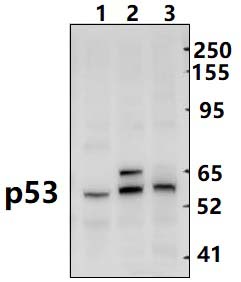
Western blot (WB) analysis of p53 polyclonal antibody at 1:5000 dilution
Lane1:PC12 whole cell lysate(40ug)
Lane2:MCF~7 whole cell lysate(40ug)
Lane3:A549 whole cell lysate(40ug)
Rabbit polyclonal antibody to p53 (S46)
-
货号:
53097 -
别名:
Cellular tumor antigen p53; Antigen NY~CO~13; Phosphoprotein p53; Tumor suppressor p53; TP53; P53 -
应用:
WB IF IP -
反应种属:
Human,Rat -
抗体类型:
Primary antibody -
Swissprot:
P04637 -
规格:
-
数量:
-+ -
说明书:

目录价¥1180



Rabbit polyclonal antibody to p53 (S46)
Description |
|---|
The p53 tumor suppressor protein plays a major role in cellular response to DNA damage and other genomic aberrations. Activation of p53 can lead to either cell cycle arrest and DNA repair or apoptosis. p53 is phosphorylated at multiple sites in vivo and by several different protein kinases in vitro. DNA damage induces phosphorylation of p53 at Ser15 and Ser20 and leads to a reduced interaction between p53 and its negative regulator, the oncoprotein MDM2. MDM2 inhibits p53 accumulation by targeting it for ubiquitination and proteasomal degradation. p53 can be phosphorylated by ATM, ATR, and DNA~PK at Ser15 and Ser37. Phosphorylation impairs the ability of MDM2 to bind p53, promoting both the accumulation and activation of p53 in response to DNA damage. Chk2 and Chk1 can phosphorylate p53 at Ser20, enhancing its tetramerization, stability, and activity. p53 is phosphorylated at Ser392 in vivo and by CAK in vitro. Phosphorylation of p53 at Ser392 is increased in human tumors and has been reported to influence the growth suppressor function, DNA binding, and transcriptional activation of p53. p53 is phosphorylated at Ser6 and Ser9 by CK1δ and CK1ε both in vitro and in vivo. Phosphorylation of p53 at Ser46 regulates the ability of p53 to induce apoptosis. Acetylation of p53 is mediated by p300 and CBP acetyltransferases. Inhibition of deacetylation suppressing MDM2 from recruiting HDAC1 complex by p19 (ARF) stabilizes p53. Acetylation appears to play a positive role in the accumulation of p53 protein in stress response. Following DNA damage, human p53 becomes acetylated at Lys382 (Lys379 in mouse) in vivo to enhance p53~DNA binding. Deacetylation of p53 occurs through interaction with the SIRT1 protein, a deacetylase that may be involved in cellular aging and the DNA damage response. |
Specification |
|
|---|---|
| Aliases | Cellular tumor antigen p53; Antigen NY~CO~13; Phosphoprotein p53; Tumor suppressor p53; TP53; P53 |
| Swissprot | P04637 |
| WB Predicted band size | ~55kDa |
| Host/Isotype | Rabbit IgG |
| Antibody Type | Primary antibody |
| Storage | Store at 4°C short term. Aliquot and store at ~20°C long term. Avoid freeze~thaw cycles. |
| Species Reactivity | Human,Rat |
| Immunogen | Synthetic peptide, corresponding to Human p53. |
| Formulation | 1mg/ml in PBS with 0.02% sodium azide, 50% glycerol, pH7.2. |
Application |
|
|---|---|
| WB | 1/5000~1/10000 |
| IP | 1/50 ~ 1/100 |
| IF/ICC | 1/50 ~ 1/100 |
For Reseach Only
Application Key:WB - Western Blot | IHC - Immunohistochemistry | ICC - Immunocytochemistry | FCM - Flow Cytometry | ELISA - Enzyme-linked Immunosorbent Assay | IP - Immunoprecipitation
#53097
相关产品



联系方式
CONTACT-
联系电话:
0731-88388785 -
公司邮箱:
sales@promab.cn -
公司地址:
湖南省长沙市高新开发区林语路239号顺畅产业园5楼
 官方微信
官方微信
产品中心
Product技术服务
service客户留言
message